Bathroom Lighting and Ventilation That Get Overlooked
Share this article
Quick Answer: Bathroom lighting and ventilation are the two systems most often treated as afterthoughts, and they shape how the room performs every day. Good lighting comes in layers: ambient light for the whole room, task light placed at face height beside the mirror, and a fixture rated for damp locations inside the shower. Good ventilation means a fan sized for the room, quiet enough that people actually run it, and ducted to the outdoors rather than into an attic or wall cavity. Plan both before the finishes are chosen, because the ceiling, walls, and wiring are easiest to change while the room is open.
Most bathroom remodel conversations begin with the fun parts. Tile, a vanity, the shower glass, the faucet finish. Those choices deserve the attention they get, but they sit on top of two quieter systems that decide whether the finished room feels good on an ordinary Tuesday morning. One is the light you see yourself and the room by. The other is the air, and how quickly the room gets rid of the moisture a hot shower puts into it.
Both get overlooked for the same reason. They are hard to photograph and easy to postpone. A fan is a grille in the ceiling. A light fixture is one line on a shopping list. Yet a beautiful bathroom with a single dim ceiling light and a weak fan will disappoint you within a year, and the problems it creates, from harsh shadows to fogged mirrors to dark spots on the ceiling, tend to grow quietly.
Here in Chapel Hill and across the Triangle, the stakes are a little higher. Our summers are long and humid, many of the homes we work in were built decades ago with modest fans or none at all, and a bathroom that cannot shed moisture will hold it for hours. This article walks through what we look at first when we plan lighting and ventilation for a bathroom, and why we treat them as design decisions rather than hardware.
Why These Two Systems Belong in the Same Conversation
Lighting and ventilation share more than a ceiling. They compete for the same space, and the fan duct needs a clear, short path to an exterior wall or roof. When lighting gets decided late, it tends to push the fan into a poor location, or the other way around.
They also affect each other in daily use. A fixture not rated for the damp air near a shower will corrode early, especially when the fan is too weak to clear the room. A fan that is loud enough to annoy gets switched off, and then your carefully chosen lighting shines on a room full of condensation.
The Lighting Mistake Almost Everyone Makes
The most common bathroom lighting plan is a single fixture in the middle of the ceiling, sometimes joined by a bar of bulbs above the mirror. It feels adequate in the showroom and fails at the mirror.
The reason is geometry. Light from directly overhead falls on the top of your forehead, the tip of your nose, and the top of your cheekbones, and leaves the eye sockets, under the nose, and the chin in shadow. Shaving, applying makeup, or checking your face in that light means working against your own shadow. A fixture above the mirror helps a little, but it still throws light down across the face rather than onto it.
Light the face, not the ceiling
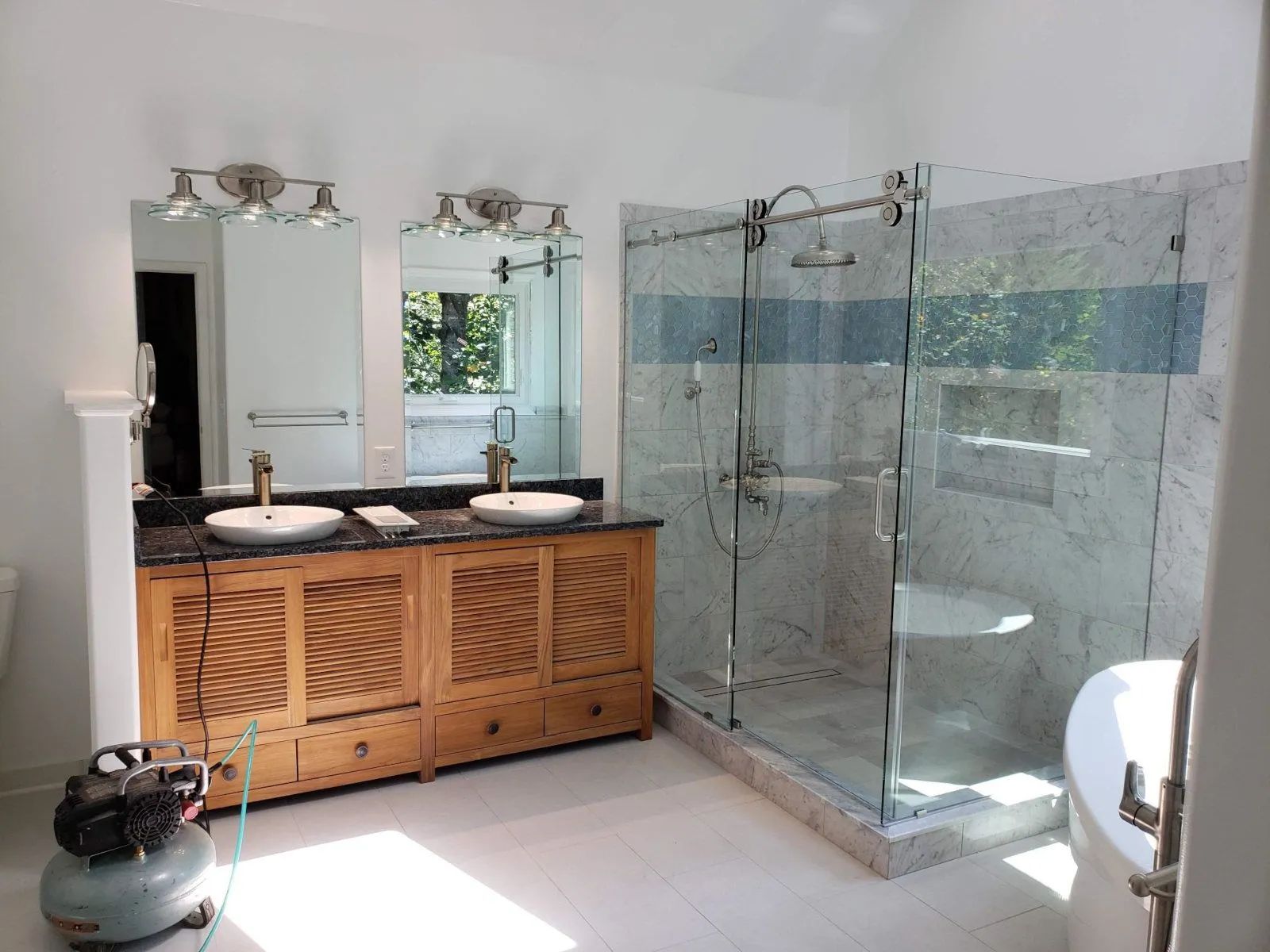
The fix is to bring light in from the sides. A pair of vertical fixtures flanking the mirror, or a mirror with built in lighting along its edges, puts even light across both sides of your face at once. Mounted with the center of each fixture roughly at eye level, they wash out the shadows that overhead light creates. When a wall layout makes side placement impossible, a wide fixture above the mirror combined with light from below, such as a lit vanity toe kick or a bright, light colored countertop that bounces light upward, softens the effect.
Double vanities give you a natural advantage here. Two mirrors mean two sets of side fixtures, and each person gets their own clean light rather than sharing a shadow.
Build three layers
We plan bathroom lighting in three layers, and each one has a different job.
Ambient light fills the room so you can walk in at night, find a towel, or clean the floor. It usually comes from recessed lights or a flush fixture in the ceiling, ideally spread over more than one point so no corner sits in gloom.
Task light does the precise work at the mirror and, in larger rooms, at a makeup counter or over a separate toilet room. This is the side lighting described above.
Accent light adds depth. A shallow niche in the shower wall with a small light in it, a soft glow under a floating vanity, or a wall washer on a textured tile surface all make the room feel finished. Accent lighting is also the layer most homeowners skip, and the one they most often say they wish they had added while the walls were open.
Put each layer on its own switch, and put a dimmer on at least the ambient layer. A bathroom at six in the morning and a bathroom at ten at night have different needs, and one fixed brightness serves neither well.
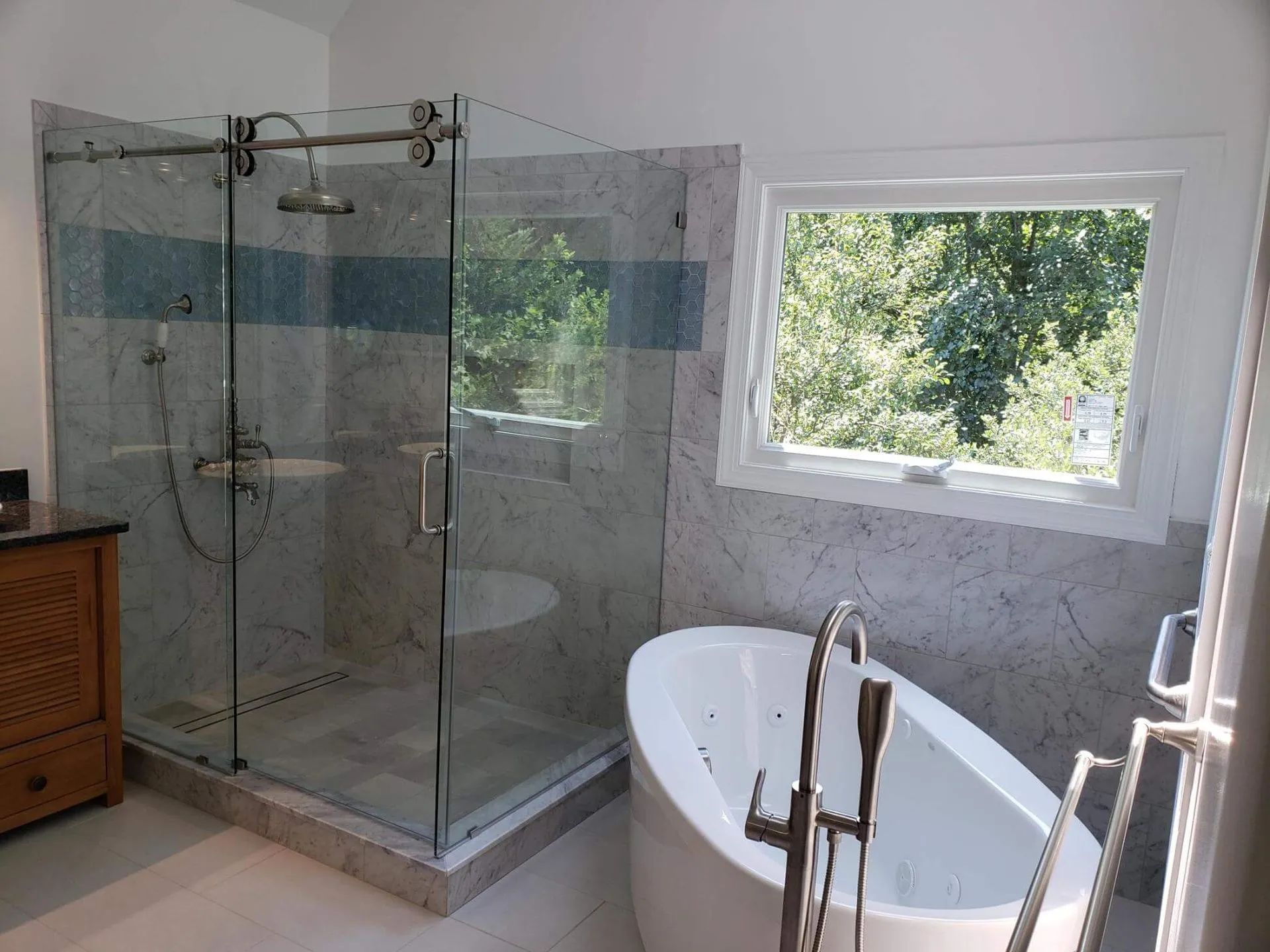
Glass selection matters here too. A frameless panel or a doorless walk-in layout skips the awkward maneuvering a swinging shower door creates in a tight space, and it keeps the sightline open so the whole room reads as one continuous surface instead of a set of separated boxes.
Color Temperature and Color Rendering: The Details Behind the Glow
Two numbers on a light bulb package quietly decide whether your bathroom looks flattering or flat.
Color temperature, measured in Kelvin, describes how warm or cool the light appears. Lower numbers, around 2700 to 3000 Kelvin, produce the soft, warm glow of traditional incandescent bulbs. Higher numbers, 4000 Kelvin and up, look bluer and more clinical. In a bathroom, warm to neutral white usually works best, because it flatters skin tones and keeps stone, wood, and painted surfaces looking the way they did in the sample. Very cool light can make a carefully chosen warm tile look gray.
The second number is color rendering, often listed as CRI. It measures how accurately a light shows true colors on a scale up to 100. A bulb with a low rating can make a healthy complexion look tired and a coordinated color palette look off. For a room where you judge skin, hair, and fabric color every day, a rating of 90 or higher is worth looking for.
TIP: Buy every bulb in the bathroom from the same product line, and match the color temperature across all of them, including the mirror lights, the ceiling fixtures, and any accent strips. Mixed temperatures in one small room make it look patchy, even when each fixture looks fine on its own.
The Shower Deserves Its Own Light
A shower with no dedicated light is one of the most common gaps we see in older Triangle bathrooms. The room's general light has to pass through a glass door or curtain, which dims it, and the person inside ends up reading the labels on shampoo bottles in shadow.
A fixture over the shower solves this, but it has to be the right kind. The manufacturer's rating tells you where a fixture can safely go. Fixtures marked for damp locations handle humid air, while those marked for wet locations are built to handle direct water spray. Anything that sits in the shower enclosure needs the appropriate rating, and a fixture that lacks it will corrode, flicker, and eventually fail. Ask the installer to confirm the rating on the packaging before it goes up.
Where the shower has a ceiling high enough and a glass panel that lets light through, a single well placed recessed light can do the job. In a steamy, enclosed shower, a fully sealed fixture with a trim that resists moisture is the better choice. Position it slightly in front of where you stand rather than directly overhead, so it lights your face and body without glare.
Ventilation: The System That Protects Everything Else
Lighting shapes how a bathroom looks. Ventilation determines how long it looks that way.
A hot shower releases a surprising amount of water vapor. That moisture has to go somewhere. If the fan does not move it outdoors, it settles into the ceiling paint, the grout, the caulk lines, the wood trim, and the wall cavities behind the tile. In a humid Piedmont climate, where the air outside is already damp for much of the year, that moisture lingers longer than it would in a dry region. The result is the familiar list of complaints: peeling paint, dark spots on the ceiling, mildew in the grout, a musty smell, swollen door casings, and, over time, damage to what is behind the walls.
Size The Fan To The Room
Fans are rated by CFM, or cubic feet per minute. A common guideline is about one CFM per square foot in modest bathrooms, with adjustments for larger rooms, taller ceilings, steam-heavy showers, and soaking tubs. Oversized fans can also waste energy.
Quiet Fans Get Used
Fan noise is measured in sones, with lower numbers meaning quieter operation. A fan rated at one sone or less is barely noticeable, while older builder-grade models can be much louder. Quieter fans are more likely to stay running throughout the shower.
Where The Air Goes Matters As Much As How Much
The duct should carry bathroom air completely outdoors through a wall or roof cap. Exhausting into an attic, soffit cavity, or crawl space only relocates moisture, where it can condense on framing and insulation and cause hidden damage over time.
WARNING: Do not vent a bathroom fan into the attic or a crawl space, even if the fan looks like it is doing its job. The moisture it carries will condense on the coldest surfaces it meets, feeding mildew and rot in places you cannot see until the damage is well advanced.
Placement Inside The Room
Place the fan near the shower or tub, where moisture originates, rather than beside the door. A tight door seal can restrict replacement air, so an undercut helps. Larger bathrooms with separate compartments may benefit from two smaller fans.
Smarter Controls That Make Both Systems Easier to Live With
Good hardware can still be undermined by poor controls. A few choices make a big difference in how the room performs when nobody is thinking about it.
Humidity sensing fans turn on automatically when the room gets damp and run until it dries out. They take the guesswork out of it, which matters for guests, teenagers, and anyone who forgets. Timer switches let the fan run for a set period after you leave, since a good rule is to keep it running for 20 minutes or more after a shower. Separate switches for the fan and the lights keep you from running one to get the other, and a dimmer with a warm glow setting gives you a gentler light at night without turning on a bright overhead.
Planning Both Systems Into a Remodel
The best time to fix lighting and ventilation is when the ceiling and walls are open. Running new wiring for side lighting, rerouting a duct to the exterior, or adding a dedicated shower fixture is a fraction of the work it becomes once tile and drywall are finished. Retrofitting later often means opening a finished surface you just completed.
That is why we bring both systems into the very first design conversation, right beside the layout and the fixture selections. We look at the ceiling framing, the path the duct will take, the location of the mirror, the switches, and the finishes, and we make the choices together. The layout might shift by a few inches to give the fan a clean route or to center a light on the mirror. Those small adjustments made early are what separate a bathroom that looks good on the first day from one that works well every day after that.
Frequently Asked Questions
Do I really need a separate light inside the shower?
In most cases, yes. Ceiling light is dimmed by glass or a curtain, so the shower feels dark and shadowy. A single light rated for the enclosure makes the space easier to use and clean.
How do I know if my bathroom fan is strong enough?
Watch the mirror after a hot shower. If it stays fogged long after you finish, the fan is likely undersized, blocked, or not venting well. Peeling ceiling paint or dark spots are other warning signs.
Is a quiet fan really worth the extra attention?
Yes. A quiet fan gets used, and a fan that gets used protects the room. The most powerful fan in the world does nothing if someone switches it off because of the loud, constant noise.
What color of light is best for a bathroom?
Warm to neutral white, roughly 2700 to 3000 Kelvin, is a dependable choice because it flatters skin and keeps finishes looking true. Pair it with high color rendering bulbs, keeping the color temperature consistent everywhere.
Can I upgrade lighting and ventilation without a full remodel?
Sometimes. Swapping a fixture or fan can be done on its own, but rerouting ducts, adding wiring, or moving fixtures is much easier while the room is open. A planned remodel is the ideal time.
Brighter, Drier Bathrooms Start With Careful Early Planning
A bathroom earns its keep in the quiet moments, when you lean toward the mirror before work or step out of a hot shower on a sticky August evening. Layered lighting gives your face clean, even light from the sides, while a dedicated shower fixture and warm bulbs with strong color rendering keep every finish looking true. Paired with a quiet, properly sized fan that sends moist air outdoors, those choices protect the paint, grout, and framing for years to come.
Across 25
years of remodeling homes in Chapel Hill, North Carolina, we've learned that small decisions carry the longest reach. A fan duct routed a few inches differently or a mirror centered between two sconces rarely shows up in photographs, yet it shapes how the room feels every morning. At Chamberlain Renovations LLC, we treat light and air with the same care as tile and cabinetry, so the bathroom you love on day one still feels right long after the dust settles.
Will Your Bathroom Still Work for You in Twenty Years? Aging-in-Place Features Worth Building In Now